

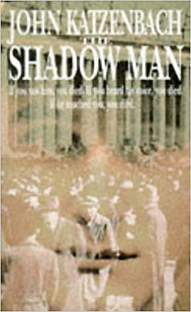
John Katzenbach
The shadow man
En Anglais – In Berlin in 1943, he was known and dreaded as Der Schattenmann–a merciless “catcher” of Jews for the Nazis. Few saw his face and lived. In present-day Miami Beach, he has resurfaced–to silence forever the survivors who remember. Unless retired homicide detective Simon Winter can find him first.
Vous aimerez aussi
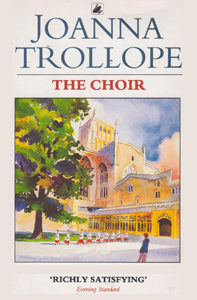
The choir
In the rustic town of Aldminster, a crisis looms. Funds are short and the cathedral is in need of major repair. Some hope to finance the work by abolishing the costly boy’s choir-while others are aghast at the idea. Drawn into the fray is Sally Ashworth, the lonely mother of a ten-year-old chorister. She is anchored only by her unexpected love for the brilliant choirmaster-and by her young son, whose melodic voice may be the only thing that can unite a divided community.

Werther, ce soir…
En cette fin des années 80, Orlando Natale est le meilleur ténor du monde. Du Metropolitan de New York à la Scala de Milan, de Covent Garden au Palais-Garnier, les foules se pressent pour l’entendre. De tous les rôles qu’il interprète, celui qu’il préfère est Werther… Et un soir, au théâtre de Mannheim, sous des tempêtes d’applaudissements, il rencontre Carola K. À partir de cet instant, l’Opéra et la Vie commencent à se ressembler étrangement… Des coïncidences se produisent à Munich, à Vienne, jusqu’à ce qu’arrive enfin la nuit de Venise où tout s’embrase dans le déferlement de l’orchestre et où théâtre et réalité se confondent.
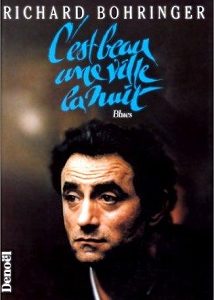
C’est beau une ville la nuit
C'est beau une ville la nuit n'est pas à proprement parler un roman autobiographique, ni une simple biographie d'acteur, mais bien plutôt l'écriture d'une errance et d'une quête. “Une balade, l’œil et l'esprit grand ouverts au vif de la ville et au droit de la vie, une route de douleurs, de joies et finalement d'espérance.” Ce livre est un fragment d'itinéraire de l'homme Bohringer avant même que les écrans renvoient cette image d'une “gueule” de cinéma et que celle-ci s'impose par la forte présence d'un comédien dont les valeurs personnelles ne se réduisent pas à sa profession et au narcissisme qu'elle entretient. Ouvert aux autres et amoureux de l'amitié, Richard Bohringer, grand lecteur de Cendrars, de Kérouac ou de London, sait donc que la raison même de l'écrivain est de mythifier la réalité de la vie, de dire vrai même dans l'imaginaire puisque “la réalité dans tout cela, ce sont les faits, les gens non pas tels qu'ils sont mais tels qu'on les vit. C'est la règle du jeu. La seule avec laquelle il acceptable de jouer.”
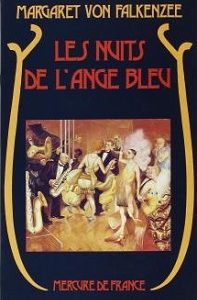
Les nuits de l’Ange bleu
Berlin à la fin des années vingt. On sort à peine du fossé bourbeux de l’inflation galopante et on ne peut encore imaginer que le gouffre du cauchemar à bottes est pour bientôt. Le présent est là, bien en chair, qui appelle toutes sortes de caresses. On se prend à rêver. La période semble propice à l’art … A l’art d’aimer aussi. On veut vivre. Il s’agit de jouir. Et c’est bien “Ouf, jouissons!” que se dit chaque jour Manfred von Klausenberg en jetant dans la recherche du plaisir le meilleur de lui-même.